St. Petersburg Polytechnic
St. Petersburg Polytechnic, in Saint Petersburg, is part of RusStudy's network of partner Russian state universities (Top Engineering). RusStudy directly supports Tunisian students through admission: application file, invitation letter, visa and settling in.
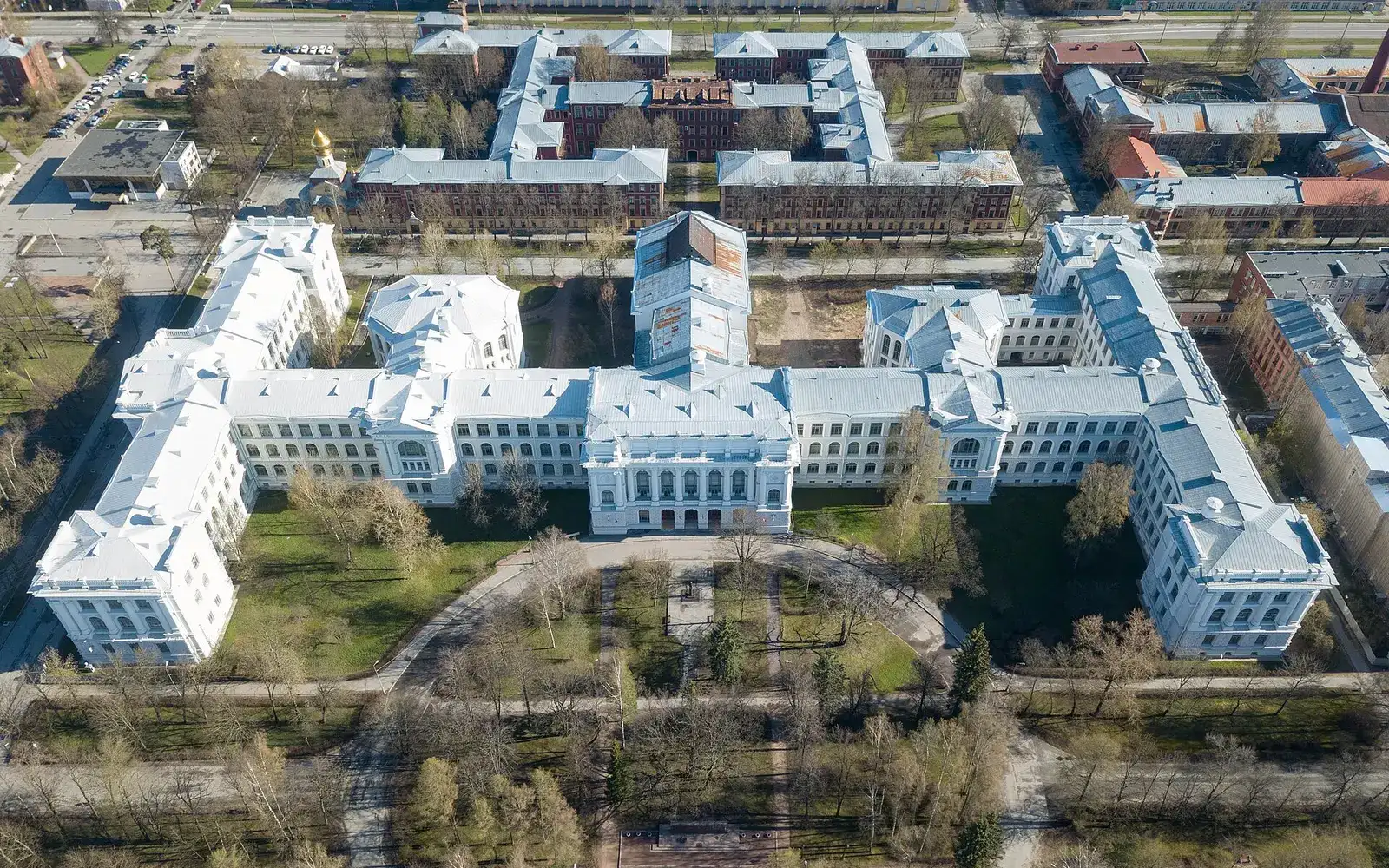
| Official name | Санкт-Петербургский политехнический университет Петра Великого |
|---|---|
| Transliteration | Sankt-Peterburgskiy politekhnicheskiy universitet Petra Velikogo |
| Founded | 1899 |
| Status | National research university, multidisciplinary with a scientific and technological focus |
| Official website | www.spbstu.ru |
Born of Russian industrialisation
Founded in 1899, Saint Petersburg Polytechnic came directly out of the industrialisation of late nineteenth-century Russia. It was designed to train the engineers industry lacked, and that vocation has shaped its identity ever since.
Scientists associated with the institution include three Nobel laureates: Pyotr Kapitsa, Nikolay Semyonov and Zhores Alferov. For a student aiming at engineering, that says more than a ranking: it speaks to the depth of the scientific tradition of the place.
Hosting international students
The university offers ten-month pre-university programmes combining Russian language and preparatory subjects, with specialisations notably in engineering, economics and humanities. This is the usual entry route for a school-leaver who does not yet master Russian.
The campus includes a complex of eighteen halls of residence. Allocation of a place nevertheless remains to be confirmed at admission.
Studying in Saint Petersburg
Saint Petersburg sits in between within the network: more affordable than Moscow, more expensive than the regional cities, with a cultural and academic density comparable to the capital. The page devoted to the city details the climate, cost of living and student life there.
What to verify with the institution
The university has an international catalogue allowing programmes to be filtered by language, which makes checking easier. Three points remain to be confirmed directly.
- Whether the specialty you are targeting is open to international students this year, and its exact code
- The language of instruction of the full course, not of a few modules only
- The effective allocation of a place in halls
Programmes open to international students
The status of each of the five programmes we document. "To be verified" means no institutional source allowed us to settle the question: it is neither a yes nor a no, and it is confirmed with the institution for the academic year concerned.
| General medicine | Not offered |
|---|---|
| Engineering and technology | Offered |
| Pharmacy | Not offered |
| Dentistry | Not offered |
| Economics and management | Offered |
Languages of instruction
Language depends on the programme, not on the university. Some courses may be offered in English while others are taught in Russian: the language of instruction must be verified for the chosen programme before applying.
Preparatory year of Russian
The institution has a preparatory structure for international students. It allows you to prepare for study in Russia, particularly in the Russian language and, depending on the case, in the subjects needed for your future course. Duration, content and fees are to be confirmed with the university.
University halls of residence
The campus includes a complex of eighteen halls of residence.
University halls are available, subject to allocation conditions and available places. The existence of a housing stock does not guarantee that a place will be allocated to every international student.
Can this university suit a Tunisian, Moroccan or Algerian student?
Admission requirements vary by programme and by the nationality of the applicant. A Tunisian, Moroccan or Algerian student must check the official requirements applying to their own file before starting the procedure. Here are the points to check, in this order.
- Your secondary school leaving certificate and its recognition by the institution you are targeting
- Whether the programme you want is open to international students for the year concerned
- The language of instruction of the full course, and the level required
- Whether a preparatory year of Russian is needed
- Any admission tests or interviews
- The exact list of documents to be translated and legalised
- The lead times for the invitation letter and the student visa
- Accommodation arrangements and the total annual budget
Official sources
The information on this page comes from the institutional sources below. Data sensitive to change — fees, open programmes, language of instruction, accommodation, admission requirements — must be verified with the university for the academic year concerned.
Need help with your application?
You want to study in Russia but are not sure which university or which programme to choose? RusStudy can support you in preparing your plan: choice of programme, assembling your file, pre-registration, administrative formalities and support before departure.
Frequently asked questions
Is a degree from St. Petersburg Polytechnic recognized in Tunisia?
Yes. St. Petersburg Polytechnic is a Russian state university (Top Engineering), and degrees issued by Russian state universities are recognized in Tunisia and internationally; medicine programs additionally benefit from WHO recognition.
How does RusStudy support my admission to St. Petersburg Polytechnic?
RusStudy manages your file end to end for St. Petersburg Polytechnic: sworn translation of documents, follow-up with the university, the official invitation letter, the visa file and airport pickup on arrival in Russia.